
 how-to
How to Relieve Chronic Back Pain at Home
Last Updated: November 2, 2026
Quick Summary
To relieve chronic back pain at home, start with cold compresses for 15 to 20 minutes during flare-ups, then switch to a low heating pad to relax muscles. Build a gentle daily routine of pelvic tilts, knee-to-chest stretches, cat-cow, bird-dog, glute bridges, and short walks, adding one variable at a time.
- Use cold first for flare-ups, then heat on low for 15 to 20 minutes each.
- Do a 10-minute starter routine once or twice a day when muscles are warm.
- Add one variable at a time and hold the rest steady for a week.
- Break up sitting with a 2-minute walk every 30 to 45 minutes.
- See a doctor if pain lasts more than a few weeks or spreads down a leg.
Table of Contents
- Start With Heat and Cold Therapy for Back Pain
- Build a Daily Routine With Exercises for Chronic Back Pain
- Apply Ergonomic Tips for Back Pain at Your Desk and Home
- Know When to See a Doctor for Back Pain
- Frequently Asked Questions
Start With Heat and Cold Therapy for Back Pain
Many people manage back pain at home, and heat and cold therapy is a common place to start. The VA/DoD clinical practice guidelines note that low back pain may ease within a few days with self-treatment.
Cold first for flare-ups. A cold compress numbs the area and calms inflammation. Experts at Harvard Health Publishing warn against heat right after an injury. Use cold for 15 to 20 minutes at a time.
Then switch to moist heat after a few days. Moist heat relaxes muscle tension and eases stiffness before you move. Keep it low for 15 to 20 minutes.
Here is how to time cold and heat when back pain flares up.
Therapy | When to use | How long |
|---|---|---|
Cold compress | First, for flare-ups and right after an injury | 15 to 20 minutes at a time |
Moist Heat | To relax muscles and ease stiffness | 15 to 20 minutes on low |
Build a Daily Routine With Exercises for Chronic Back Pain
Gentle daily movement is a common part of managing chronic back pain at home. NIH research on non-drug therapies shows exercise, massage, and spinal manipulation can give relief, and current guidelines favor active self-management over passive rest. The key word is gradual: a small routine done consistently is generally easier to sustain than an aggressive session.
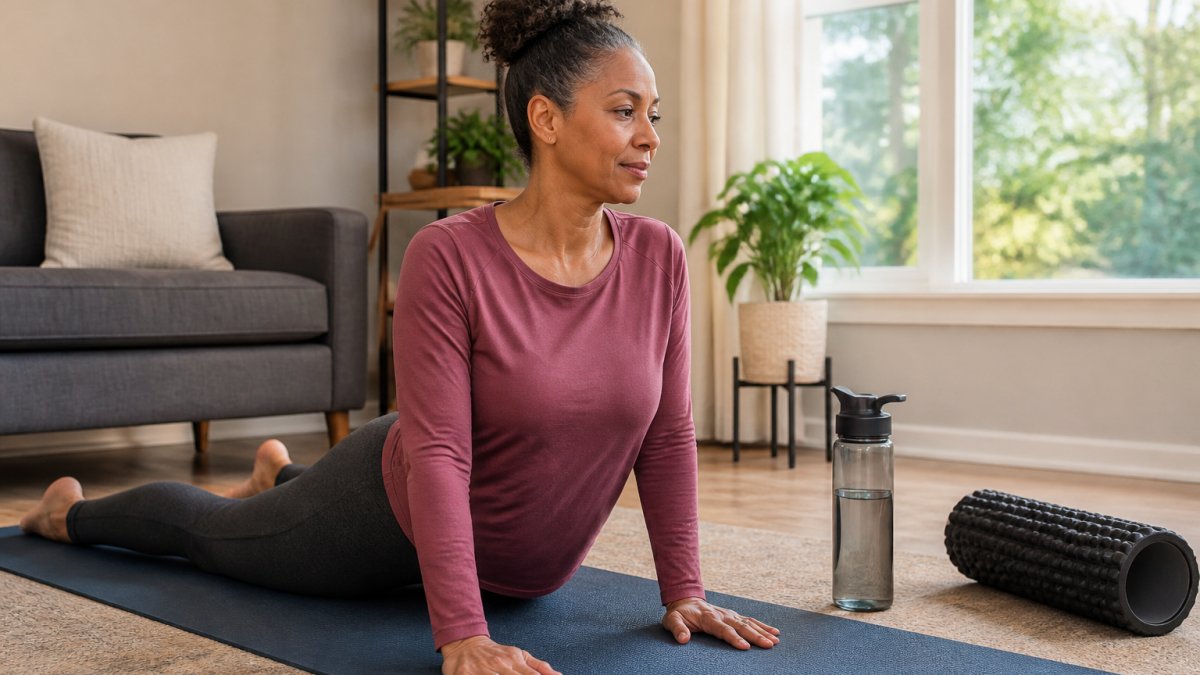
A starter routine you can do in 10 minutes
Do this once or twice a day, ideally when muscles are warm (after a shower or short walk):
- Pelvic tilts: 10 slow reps. Lie on your back, knees bent, and gently flatten the lower back into the floor, holding 5 seconds each rep.
- Knee-to-chest stretch: hold 20 seconds per side, 2 rounds. Keep the opposite foot flat on the floor.
- Cat-cow: 8 slow reps, moving with your breath, inhale to arch, exhale to round.
- Bird-dog: 8 reps per side, holding 3 seconds. This trains the deep spinal stabilizers that protect the lower back during daily lifting.
- Glute bridge: 10 reps, squeezing the glutes at the top.
- Short walk: 10 to 15 minutes, building toward 30 minutes on most days.
How to progress without flaring up
Add one variable at a time, more reps, a longer hold, or a new movement, and hold the rest steady for a week. If pain stays at or below baseline the next morning, it was tolerated; if it spikes past 24 hours, back off.
Watch out: sharp, shooting, or radiating pain during any movement is a signal to stop that exercise, not to push through it.
Movement snacks beat one long session
Prolonged sitting can stiffen the spine, so breaking up the day can help: a 2-minute walk every 30 to 45 minutes, standing pelvic tilts at the counter.
What to skip
Avoid unsupported forward bends, deep twisting under load, and any stretch that produces numbness or tingling down a leg. If a movement consistently reproduces your leg symptoms, leave it out until you have been assessed.
Apply Ergonomic Tips for Back Pain at Your Desk and Home
Good ergonomics protect spinal alignment during long hours of sitting, but sleep and tension matter just as much.
Desk and chair setup
- Screen at eye level: the top of the monitor should sit at or just below eye height, about an arm's length away.
- Feet flat on the floor: if they don't reach, use a footrest rather than letting the legs dangle.
- Lumbar support: a small cushion or rolled towel in the curve of the lower back maintains the spine's natural arch.
- Elbows at roughly 90 degrees: keep wrists neutral and shoulders relaxed.
- Move every 30 minutes: stand, stretch, or walk briefly, static posture, even good posture, becomes a strain over time.
At home, lift with your legs rather than your back, keep frequently used items at waist height, and avoid twisting while carrying loads.
Sleep hygiene and mattress selection
You spend roughly a third of your life in bed, so sleep position matters. Back sleepers do best with a pillow under the knees; side sleepers need one between the knees plus a height that keeps the neck neutral. Stomach sleeping over-rotates the neck and arches the lower back.
For the mattress, most practitioners suggest a medium-firm surface that supports the spine's natural curve without pressure points; very soft mattresses let the hips sink and the lower back sag. Replace one with visible sagging.
Stress, tension, and the mind-body connection
Chronic pain and stress can feed each other, as stress may tighten the muscles around the spine and persistent pain can increase stress. Slow diaphragmatic breathing, inhaling for four and exhaling for six, can lower muscle guarding before you stretch or sleep. Mindfulness and progressive relaxation are increasingly used alongside physical therapy for chronic pain.
Watch out: if pain wakes you at night, worsens when lying flat, or comes with fever or unexplained weight loss, that pattern warrants a medical evaluation rather than a mattress change.
Know When to See a Doctor for Back Pain
See a doctor for back pain if pain lasts more than a few days, spreads down a leg, or comes with numbness or weakness. You can schedule an appointment with us. Those signs can point to nerve pain and need a professional look.
Minnesota Chiropractic and Rehabilitation provides non-invasive chiropractic and rehabilitation care in Plymouth, MN, including back pain treatment and spinal decompression therapy. You can schedule an appointment when you are ready.
Frequently Asked Questions
Will chronic back pain go away on its own?
Low back pain may resolve within a few days and can be managed at home with self-treatment, according to the Department of Veterans Affairs and Department of Defense clinical practice guidelines. Non-pharmacological therapies such as exercise, spinal manipulation, acupuncture, and massage may provide relief. If home care stops working, a professional evaluation can identify the root cause.
What are the most effective non-surgical home remedies for lower back pain?
A combination of approaches is often used in practice. Use a cold compress first for acute flare-ups, then switch to moist heat for muscle tension. Add a daily stretching and core strengthening routine, adjust your workspace with lumbar support, and stay active instead of resting in bed. Over-the-counter medication and a pain-relief cream can help during flare-ups.
When should I stop home treatment and see a professional for back pain?
Seek a professional if pain lasts more than a few days, worsens despite home care, or comes with numbness, weakness, or pain radiating down a leg. Experts also advise against using heat immediately after a back injury, since cold compresses work better to numb the area and limit inflammation. A qualified healthcare provider can evaluate your condition and discuss appropriate options.
Chronic back pain rarely fixes itself overnight, but the right home habits move you in the right direction. When home care is not enough, our team is here to help. We focus on natural, noninvasive therapies, including chiropractic care, spinal decompression, and physical rehabilitation, all aimed at the root cause. Get started with Minnesota Chiropractic and Rehabilitation and take the first step toward lasting relief.
